
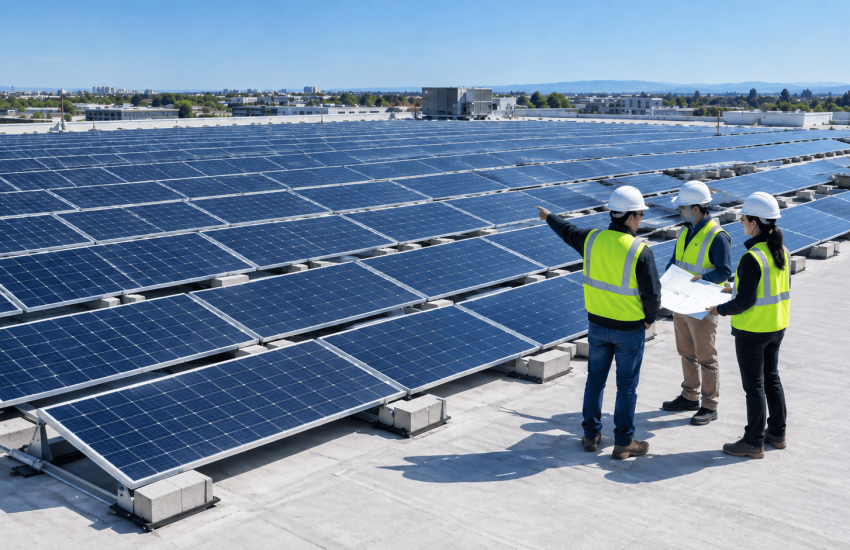
Why Solar Installers and EPC Contractors Need
Introduction
Commercial solar is expanding rapidly across the United States and Canada. For many solar installers and EPC contractors, however, winning new projects is no longer the biggest challenge. Delivering those projects efficiently has become the real test. As project pipelines grow, engineering capacity, permitting timelines, utility coordination, and operational bottlenecks often determine how quickly projects move from design to Permission to Operate (PTO).
At AM Energy Solutions, we regularly work with solar installers, EPC contractors, and developers across North America and see how engineering and operational workflows directly impact project timelines, approval cycles, and scalability. Our team supports solar companies across the United States and Canada with engineering design, permitting, interconnection, and project operations services. This support allows solar companies to take on more projects while maintaining quality, compliance, and predictable timelines.
Commercial Solar Projects Are Becoming More Complex
Over the last decade, commercial solar has moved well beyond simple rooftop arrays. Today’s projects often include larger system sizes, battery energy storage, carports and ground mounts, strict utility interconnection requirements, and detailed engineering documentation that must meet increasingly rigorous codes.
Unlike residential installations, commercial projects frequently require coordination among multiple stakeholders, including property owners, EPC contractors, engineering teams, utility companies, permitting authorities, financing partners, and installation crews.
Before a single panel goes up, teams must complete site evaluations, system design, electrical and structural calculations, permit documentation, utility submissions, compliance reviews, and project planning.
When any of these processes are delayed, project schedules are affected. Installation crews wait, customers become frustrated, and project costs begin to increase.
The reality is that commercial solar success depends as much on engineering, permitting, and operational execution before installation as it does on construction itself.
The Hidden Bottlenecks That Slow Solar Projects
A project can have equipment selected, financing approved, and crews scheduled and still stall because permit revisions and utility documentation requirements weren’t resolved early.
The most common causes of delay are engineering revisions, incomplete permit packages, utility documentation issues, corrections requested by the AHJ (Authority Having Jurisdiction), and communication gaps between stakeholders. Each one is small on its own, but together they can add weeks to a schedule before construction even begins.
While each issue may seem minor individually, delays often compound when projects are moving through multiple stakeholders and approval processes simultaneously. A small documentation error can quickly affect installation schedules, customer expectations, and project profitability.
AM Energy Pro Tip: Before submitting a commercial solar permit or interconnection package, verify that the customer name, project address, equipment model numbers, and system information match across all project documents. Small documentation mismatches can create avoidable correction cycles and delay approvals.
As project volume grows, these challenges become harder to manage internally. Many solar companies reach a point where sales outpace engineering and operational capacity. Projects keep coming in, but internal teams struggle to keep up with design requests, permit submissions, revisions, and interconnection.
The challenge is not finding more customers. The challenge is creating a scalable process that moves projects efficiently from signed agreement to PTO.
Why Engineering Support Matters More Than Ever
Every successful commercial solar project begins with accurate, permit-ready engineering.
A high-quality engineering package does more than satisfy technical requirements. It helps reduce permit revisions, improves approval timelines, supports utility interconnection requirements, and prevents rework in the field.
Solar installers and EPC contractors rely on engineering documentation for virtually every stage of project development, including permit applications, utility submissions, compliance reviews, procurement planning, and field execution.
Accurate plan sets, electrical single-line diagrams (SLDs), structural calculations, PE (Professional Engineer) stamping coordination, and utility interconnection documentation all shape how efficiently a project moves. When engineering is done right the first time, there are fewer permit comments, fewer resubmittals, and fewer surprises during installation.
For a growing solar company, reliable engineering support means faster approvals, more projects moving at once, and fewer late-stage corrections.
The Role of Operations in Project Success
Engineering may initiate a project, but operations keep it moving.
Many of the challenges faced by solar installers and EPC contractors are operational rather than technical. Permit tracking, revision management, utility communication, inspection scheduling, stakeholder coordination, documentation management, and PTO follow-up all require consistent attention throughout the project lifecycle.
Without strong operational systems, even well-designed projects can experience delays.
This is particularly important for companies managing multiple projects simultaneously. As project volume increases, maintaining visibility across every stage of development becomes increasingly difficult.
Good operations support gives every project clear ownership, visibility, and accountability throughout the development process. Permit status, utility responses, and inspection dates stay visible, so nothing waits on a forgotten email.
How AM Energy Solutions Supports Solar Installers and EPC Contractors
With experience supporting solar projects across North America, AM Energy Solutions understands the engineering, permitting, interconnection, and operational challenges that installers and EPC contractors face every day.
AM Energy Solutions helps solar installers, EPC contractors, and developers expand project capacity by providing engineering and operations support across the United States and Canada. By combining technical expertise with project execution support, the team helps clients keep commercial solar projects moving from design through PTO without requiring them to rapidly expand their internal teams.
On the engineering side, every project starts with a permit-ready package, including PV system designs, plan sets, SLDs, structural and electrical calculations, and utility interconnection documents. The team also supports solar carports, ground mounts, and battery energy storage systems (BESS), coordinates PE stamping, and handles AHJ and utility corrections directly. Each design is developed with applicable NEC requirements, local AHJ requirements, and utility standards in mind.
On the operations side, the team manages permitting and interconnection, revisions, utility communication, inspection scheduling, and PTO coordination. Because one team handles both design and follow-through, nothing falls between engineering and operations, and installers can see where each project stands from signed agreement to PTO.
Why Engineering and Operations Need to Work Together
Engineering and operations are often treated as separate functions, but successful project execution depends on both working together. Engineering teams create the technical foundation for approvals and construction, while operations teams ensure permits, utility communication, inspections, and project milestones continue moving forward. When these functions are aligned, projects experience fewer handoff delays and better visibility throughout the development process.
A Scalable Approach to Growth
This approach lets solar companies increase capacity, shorten turnaround times, and reduce administrative work while staying focused on customers and installation quality.
As the commercial solar market continues to expand, the companies that scale successfully will be those that combine accurate engineering with disciplined operations.
Hiring a larger in-house team isn’t always practical. Engineers are costly to recruit, and project volume rarely stays steady. Many installers and EPC contractors instead use an outside engineering and operations partner that fits into their workflow and scales up or down with demand. This model gives solar companies access to specialized engineering and operational expertise while maintaining flexibility as project demand changes throughout the year.
Conclusion
Commercial solar projects are becoming larger, more complex, and more demanding. While installation remains a critical part of the process, successful project delivery increasingly depends on the engineering, permitting, utility coordination, and operational activities that happen behind the scenes.
For solar installers and EPC contractors, strong engineering and operations support is no longer just a convenience; it can be a key factor in how efficiently a solar company grows. As project complexity, permitting requirements, and customer expectations continue to increase, companies that build efficient engineering and operational workflows will be better positioned to deliver projects consistently and scale sustainably.
Is your commercial solar pipeline growing faster than your internal team can support? AM Energy Solutions provides permit-ready engineering, permitting, interconnection, project coordination, and operations support to help installers and EPC contractors keep projects moving from signed agreement to PTO. Contact AM Energy Solutions at info@amenergysolution.com to discuss your project requirements, request a quote, or explore how our engineering and operations team can support your next commercial solar project.
